

FarmSolve: Regenerative Agriculture MRV for South Africa's Carbon Projects

Updated: Sep 10
Credible Data and Lasting Change for Carbon Finance in South Africa
Regenerative farming is gaining momentum in South Africa. Farmers are seeking ways to heal degraded land, adapt to climate shifts, and access new revenue streams through carbon finance. However, proving that these changes are real, measurable, and verifiable depends on one crucial element: data.
That’s where FarmSolve, developed by PowerSolve Technologies, comes into play. FarmSolve is a Monitoring, Reporting, and Verification (MRV) solution. It serves as the digital backbone of TASC’s commercial Grassland Restoration and Stewardship in South Africa (GRASS) project. This project is one of the first of its kind, bringing significant positive change for commercial livestock farmers across the country. By capturing what happens in the field, FarmSolve ensures that project activities can be verified by TASC, investors, and carbon markets.
Working With Farmers for Lasting Change
Across Southern Africa and globally, grasslands are under immense pressure. Desertification, the degradation of dry land into desert, increasingly threatens both ecosystems and livelihoods. Traditional farming methods often react to these problems with technological interventions and temporary fixes that do not address the underlying causes.
The Savory Institute clearly describes the challenges in its Foundations of Holistic Management:
Declining land productivity
Rising production costs
Pressure from global markets and complex regulations
Extreme weather events
Shifting societal expectations about land use
At the same time, the Institute highlights what is possible when land is managed in alignment with nature’s processes. By strengthening the symbiotic relationships between soil, plants, animals, and people, farmers can achieve:
Increased profits, stocking rates, and crop yields
The return of wildlife and perennial grasses
Healthier soils and ecosystems
Improved quality of life
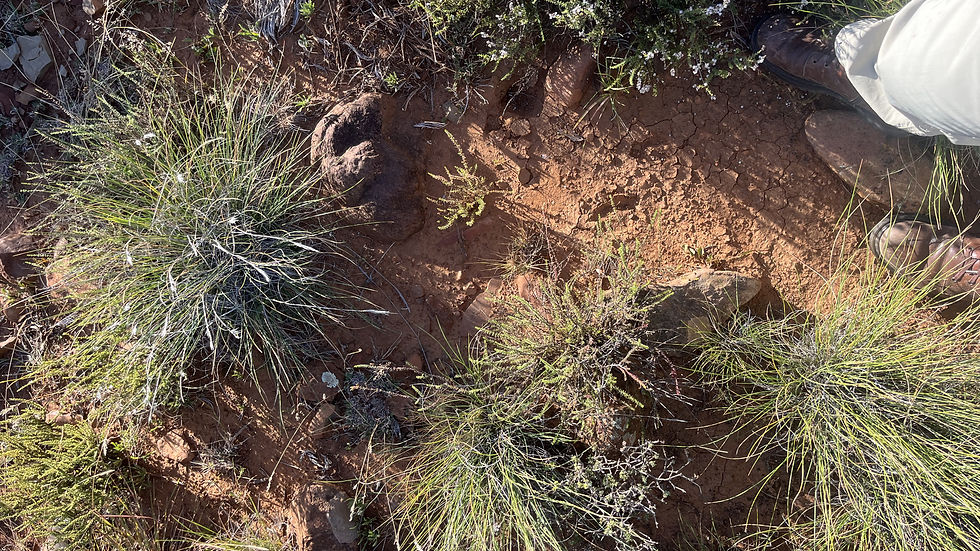
TASC’s commercial GRASS project encourages farmers to manage holistically and utilise adaptive livestock grazing management practices. These practices restore degraded soils and improve biodiversity. These changes build ecological resilience and increase soil-based carbon sequestration. This opens opportunities to generate carbon credits as a new income stream, alongside healthier livestock and landscapes. TASC has already seen these principles take root. As Carbon Portfolio Manager, Lize Kok, explains:
“The carbon project is invested in supporting farmers to transition to more regenerative grazing management by sponsoring training in regenerative land management, software to easily record day-to-day management activities, monitoring of ecological and soil indicators, and access to a team of mentors and supporters. While revenue from carbon credits will be a welcome bonus to the farmers, the true value lies in the tangible outcomes resulting from these changes. On the ground, farmers have reported more diversity in their grasslands, improved grazing conditions, and more productive livestock.”
This perspective underscores an important point: this project is about more than carbon. It’s about sustainability in its broadest sense: building farms that thrive both financially and ecologically, creating productive landscapes for future generations. When it comes to improving soil health, TASC empowers farmers to work with nature. They use tools like Ecological Outcome Verification (EOVs) to give farmers direct feedback on soil health and biodiversity indicators. This provides practical insights that guide decisions on the ground.
FarmSolve acts as the Single Source of Truth (SSoT) for project operations. Farmer onboarding data and project activities are stored and managed on FarmSolve. Information such as monthly rainfall, field size, and herd movements are logged and pulled into FarmSolve via API. Reports can be generated from this information, and calculations can be automated, such as the number of Livestock Units (LSUs) and field Rated Carrying Capacity. This data repository helps the carbon team better understand patterns in livestock activity and the results of improved land management interventions.
How FarmSolve Came About
Three partners have worked closely together to bring FarmSolve to life:
1. Healing Hooves (HH) is at the heart of farmer training. They teach the visualisation of holistic land management and regenerative grazing based on Allan Savory’s principles of Holistic Management.
They guide farmers to shift their mindset and adopt regenerative grazing practices.
They offer a rich library of resources and support to promote regenerative grazing principles and practical implementation.
They teach Biological Plans and Grazing Plans. These plans help calculate optimal herd rotations and field duration, ensuring the right animals are in the right place at the right time for the right reasons.
2. TASC is the carbon project designer and implementer. They provide the funding and coordination that ensure plans translate into action and the project generates carbon credits:
They assess farm eligibility and guide farmers through the carbon project process.
Hub Leaders, mentors who guide farmers through the transition, manage farmer onboarding onto AgriWebb and FarmSolve. Here, grazing plan data is uploaded, and actual herd movements are tracked.
Field technicians oversee soil sampling and Ecological Outcome Verification (EOV) to provide farmers with feedback and monitor environmental impact.
The carbon team measures the increase in soil-based carbon sequestration and prepares the project for verification and carbon credit issuance.
3. PowerSolve Technologies manages the design and maintenance of FarmSolve, creating a digital backbone that grows and evolves with the project:
It integrates with AgriWebb to capture detailed farm data like herd movements and monthly rainfall.
It generates a fully auditable data trail, ensuring transparency, traceability, and legitimacy.
It generates reports on farms and automates data cleaning and flagging of overdue tasks.
It enables TASC to prove impact and provide stakeholders with confidence that project activities are real and measurable.

Where FarmSolve and the GRASS Project Stand Today
The first cohort of 8 commercial farmers was onboarded for the 2023–2024 grazing season, laying the foundation for practical implementation of regenerative grazing and data tracking. A second cohort of 34 farmers joined for 2024–2025, followed by 67 more for 2025–2026. Onboarding for the 2026–2027 season is already underway, with 13 farmers signed on so far and more interest coming in.
This pace of growth, from a single cohort of 8 to well over 100 farmers across four seasons, is part of why farmer onboarding has recently been digitised within FarmSolve (see "What's Next for FarmSolve" below).
Tracking real herd movement data is challenging to visualise. However, increasing feedback from TASC and farmers is allowing FarmSolve to become more intuitive and multifunctional. Each new cohort contributes to a richer dataset, strengthening the overall story of land regeneration.
As TASC CFO Malcolm Stewart put it, “In a short period of implementation, the tangible changes in the landscape are encouraging us to continue working to promote rangeland stewardship across South Africa.” The scale of the project is also increasing rapidly. Nearly 150,000 hectares of regenerative land are set to be included in the verification process for the second grazing season. Since the project began, TASC has expanded its team of hub leaders and extended its reach to the Free State, KwaZulu-Natal, and the Eastern Cape.
It’s important to note that the true value of these efforts is revealed over time. While early signs of progress can be seen within a single season, such as improvements in soil health, grass growth, and livestock quality, the full impact on the land unfolds over decades.
Why Regenerative Agriculture MRV Matters: Beyond Carbon
FarmSolve will allow this type of carbon offset project to be replicated globally. It ensures credibility is built into the project from the ground up. This enables project developers to demonstrate real, measurable change and access carbon finance with confidence.
But the story of this digital regenerative agriculture MRV solution goes far beyond carbon. The real impact lies in the co-benefits: healthier soils, stronger ecosystems, more resilient farms, and improved animal production. For the farmers, these tangible improvements are the true reward. The carbon credits are simply an added benefit that contributes to enabling this transformation.
The lessons here demonstrate that with the right mix of knowledge, support, and technology, regenerative grazing can deliver measurable environmental, economic, and social benefits. This proves that sustainable farming isn’t just an ideal; it’s the future.

What's Next for FarmSolve
FarmSolve has been in use since the early stages of the GRASS project and has scaled alongside it, from a single cohort of 8 farmers to well over 100 across four grazing seasons. Feedback from TASC's field teams and hub leaders has shaped changes to how herd movement data is captured and visualised, and this process continues as new cohorts of farmers are onboarded.
Two recent additions, both released in beta, extend the platform beyond its original scope of project data collection and monitoring. The first digitises farmer onboarding, allowing onboarding activities to be tracked within the platform rather than managed manually. The second is a farm diary, giving farmers and programme administrators a digital record of events happening on individual farms and how they may affect carbon outcomes and project performance.
Together with FarmSolve's existing role as the project's Single Source of Truth, these additions are building toward a central, auditable record of farm activity, onboarding milestones, and programme information, the kind of history that supports both day-to-day management and long-term verification. The next phase of work focuses on making this data easier for non-technical users to interpret, since much of an MRV system's value depends on whether day-to-day users can act on what it shows them.
Scaling Regenerative Agriculture MRV Beyond GRASS
The GRASS project is the first live deployment of FarmSolve, but the underlying approach, a digital record that ties farm-level activity to verifiable outcomes, applies to other regenerative agriculture projects facing the same challenge: proving that on-the-ground change is real, measurable, and ready for scrutiny by TASC, investors, and standards bodies.
References
Savory Institute. The Foundations of Holistic Management. Savory Institute, 2024.
Kneale, Alexa. Inter-Plant Spacing in Grasslands, Graaff-Reinet, May 2025.
Kneale, Alexa. Happy Cows in a Field, Graaff-Reinet, May 2025.